Canon 40D 10.1 MegaPixel Professional Infrared-Enabled Camera
DISCONTINUED. This model has been replaced by the Canon 50D.
Models:
XNiteCanon40D : UV + Visible + IR
XNiteCanon40DIR : Dedicated IR-Only. 715nm or 830nm.
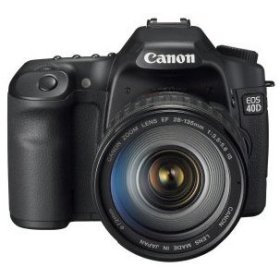
The Canon 40D is a professional digital SLR camera. Because of the nature of the IR enabling modification, we do not recommend this camera to anyone who does not fully understand the implications of the modification.
Note: Spectral Response Curve for the 40D is now available!.
We can modify this camera to be UV+IR+Visible or IR-Only. An IR+Visible camera will see both Infrared and Visible light after modification. IR Only cameras have the option of being setup with an internal 715nm or 830nm filter.
An IR-Only 715nm camera will only see IR from 715nm through 1200nm. The IR-Only camera has an internal 715nm IR filter with an antiflection coating. The 715nm filter performs similarly to the Hoya RM72 and Wratten 89B.
An IR-Only 830nm (87C equivalent) camera will see IR from 830nm through 1200nm. Because the 830nm sees less light, you will lose about 2 F-Stops. You will gain a higher resolution picture because the RGB channels will be more closely balanced. Because camea sensors have 1 red, 1 blue and 2 green pixels for every 4 pixels, and because the red channel is the most open to IR, with a 715nm filter, about 65% of the image comes though the red pixels. Thus, 65% of the data is coming in on 25% of the pixels. With an 830nm filter, the channels are much better balanced because of the way the mosaic color dyes on the sensor open up in IR. When the channels are better balanced, the camera can resolve better.
| UV+IR+Visible | IR-Only | |
| Model | XNiteCanon40D | XNiteCanon40DIR |
| Camera can take normal visible pictures | Yes with CC1 filter | No |
| Camera can take IR pictures | Yes with external IR filter | Yes with no extra filters |
| Camera autofocus will work with IR pictures | No | Yes |
| Camera autoexposure will work with IR pictures | No | Yes. With 830nm, Exp Comp = +2.0 |
| User can see through lens when taking IR pictures | No | Yes. Filter is internal. |
Modification will void your warranty.
We can modify your Canon 40D for a $450 fee + return shipping & handling ($20 for UPS ground insured within continental USA).
General
- Product Type
- Digital camera - SLR
- Weight
- 1.5 lbs
- Width
- 5.7 in
- Depth
- 2.9 in
- Height
- 4.3 in
- Body Material
- Magnesium alloy
Main Features
- Resolution
- 10.1 megapixels
- Sensor resolution
- 10.1 megapixels
- Optical Sensor Type
- CMOS
- Effective Sensor Resolution
- 10,500,000 pixels
- Total Pixels
- 10,100,000 pixels
- Light Sensitivity
- ISO 3200, ISO 100-1600
- Field of View Crop Factor
- 1.6
- Max Shutter Speed
- 1/8000 sec
- Sensor Dust Reduction
- Yes
- Min Shutter Speed
- 30 sec
- Sensor Features
- EOS Integrated Cleaning System
- X-sync Speed
- 1/250 sec
- Exposure Metering
- Spot, Evaluative, Partial (9%), Center-weighted
- Exposure Modes
- Bulb, Manual, Program, Automatic, Depth-of-field, Shutter-priority, Aperture-priority, E-TTL II program flash
- Exposure Compensation
- ±3 EV range, in 1/2 or 1/3 EV steps
- White Balance
- Custom, Presets, Automatic
- White Balance Presets
- Flash, Shade, Cloudy, Daylight, Fluorescent, Tungsten light, 2500K - 10000K (100K steps)
- Status LCD Display Information
- Program, Aperture, Drive mode, Film speed, Flash mode, Focus area, Frame counter, Metering mode, Photo quality, Shutter speed, Autofocus mode, Self-timer mode, Photos remaining, Battery condition, Manual focus mode, Red-eye reduction, Exposure compensation, White balance indicators
- Still Image Format
- RAW, JPEG, RAW + JPEG
- Continuous Shooting Speed
- 6.5 frames per second
- Color support
- Color
- Exposure Range
- EV -0.5-18 ( ISO 100 )
- Exposure Metering Zones
- 35
- White Balance Bracketing
- Yes
- Status LCD Display Illumination
- Yes
- Remote Control
- Optional
- TV Tuner
- None
Memory / Storage
- Flash Memory
- None
- Floppy Drive
- None
- Image Storage
- RAW, JPEG 3888 x 2592 - 3.5 MB, JPEG 2816 x 1880 - 2.1 MB, JPEG 1936 x 1288 - 1.2 MB, RAW 3888 x 2592 - 12.4 MB, RAW 1936 x 1288 - 7.1 MB
- Supported Flash Memory
- Microdrive, CompactFlash
Lens System
- Lens System Mounting
- Canon EF
Additional Features
- Self Timer
- Yes
- Self Timer Delay
- 2 sec, 10 sec
- Flash Terminal
- Hot shoe, PC terminal
- Additional Features
- AE lock, AF lock, Wi-Fi ready, DPOF support, Direct print, Auto power save, Histogram display, LCD live view mode, PictBridge support, USB 2.0 compatibility, Digital image rotation, RGB primary color filter, Display brightness control, Depth-of-field preview button
Camera Flash
- Type
- Pop-up flash
- Flash Modes
- E-TTL, Auto mode
- Red Eye Reduction
- Yes
- Features
- AF illuminator, Flash +/- compensation
- Guide Number (m / ISO 100)
- 13
Viewfinder
- Viewfinder Type
- Optical - Fixed eye-level pentaprism
- Color support
- Color
- Field Coverage
- 95%
- Magnification
- 0.95x
- Dioptric Correction Range
- -3 to +1
- Frames
- Autofocus frame
- LCD Display Information
- AE lock, Aperture, AF-in-focus, Shutter speed, Red-eye reduction, Exposure compensation, Flash charge completion
Display
- Type
- LCD display - TFT active matrix - 3 in - Color
- Mounting
- Built-in
- Resolution
- 230,000 pixels
Digital Player (Recorder)
- Type
- None
Microphone
- Type
- None
Connections
- Connector Type
- 1 x Composite video output, 1 x Flash terminal, 1 x Remote control, 1 x USB
- Expansion Slot(s)
- 1 x CompactFlash Card - Type I/II
Lens Systems
- Auto Focus
- TTL phase detection
- Auto Focus Points (Zones)
- 9
Miscellaneous
- Carrying Case
- None
- Cables Included
- 1 x Video cable, 1 x USB cable
- Included Accessories
- Body cap, Neck strap
- Min Operating Temperature
- 32 °F
- Max Operating Temperature
- 104 °F
Power
- Power Device
- Battery charger - External
Battery
- Supported Battery
- 1 x Li-ion rechargeable battery - 1390 mAh ( Included )
Software
- Type
- Drivers & Utilities
